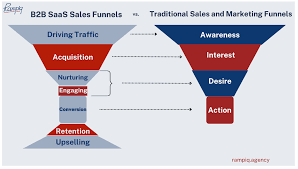

B2B SaaS products often come with long and complex sales cycles. Buyers research extensively, evaluate multiple alternatives, consult teams, assess ROI, and only then make a decision. These extended journeys require more than simple lead-generation tactics—they demand sophisticated, multi-touch funnels that nurture prospects at every stage of awareness, consideration, and evaluation.
A specialized SaaS marketing agency understands how to design these multi-layered funnels by combining data intelligence, behavior-driven engagement, and personalized content strategies. These multi-touch systems ensure that prospects stay connected, informed, and confident enough to convert, even when the decision-making process spans weeks or months.
This blog explores how a SaaS marketing agency builds these multi-touch funnels to drive predictable growth in long sales cycles.
1. Why Long Sales Cycles Need Multi-Touch Funnels
In B2B SaaS, purchasing decisions are not linear. Buyers explore multiple content sources, revisit product pages, interact with demos, speak with sales teams, and evaluate proof of value before committing.
Long sales cycles typically involve:
- Multiple decision-makers
- Budget approvals
- Technical evaluations
- Product comparisons
- Risk assessments
A SaaS marketing agency recognizes that a single touchpoint—like a demo request or email—is rarely enough. Multi-touch funnels ensure that prospects receive value-driven content repeatedly across channels until they’re ready to convert.
2. Understanding the Buyer Journey Through Data Intelligence
The foundation of any effective multi-touch funnel is a deep understanding of the buyer journey. A SaaS marketing agency uses analytics tools to map how prospects behave at each stage.
This includes studying:
- Traffic sources
- Page interactions
- Content engagement
- Funnel drop-offs
- Lead scoring patterns
- Time taken between touches
By analyzing these signals, agencies build a clear picture of what prospects need at each stage of the decision cycle.
3. Creating Segmented Audience Pathways
Different buyers require different engagement strategies. For example:
- CTOs prefer technical documentation
- Marketing teams want case studies
- Finance teams need ROI calculators
- End-users look for product tutorials
A SaaS marketing agency creates segmented funnels based on:
- Industry
- Company size
- Buying role
- Pain points
- Behavior triggers
- Lead intent
This ensures that each prospect receives the right message, on the right channel, at the right time.
4. Designing High-Value Content for Every Stage
A multi-touch funnel thrives on content that educates, influences, and reassures prospects along their journey.
A SaaS marketing agency builds content assets aligned with the funnel:
Top-of-Funnel (Awareness)
- Blogs
- Guides
- Infographics
- Social content
- Explainer videos
Mid-Funnel (Consideration)
- Webinars
- Case studies
- Competitor comparisons
- Email sequences
- Product walkthroughs
Bottom-of-Funnel (Decision)
- Demos
- ROI calculators
- Proof-of-value reports
- Trial support
- Personalized outreach
This strategic layering keeps prospects engaged, regardless of how long the buying cycle lasts.
5. Using Multi-Channel Touchpoints to Stay Top-of-Mind
SaaS buyers move across channels often. A specialized SaaS marketing agency ensures consistent communication through:
- Email nurturing
- Retargeting ads
- LinkedIn campaigns
- Paid search
- In-product messages
- Chatbots
- SMS reminders (where relevant)
- Sales-enablement outreach
Each touchpoint reinforces value, builds trust, and strengthens brand recall without overwhelming the prospect.
6. Leveraging Automation for Timely and Personalized Engagement
Long sales cycles rely on automation to keep nurturing efficient and timely. A SaaS marketing agency uses marketing automation tools to:
- Trigger emails based on behavior
- Score leads automatically
- Move leads between funnel stages
- Personalize content based on interaction
- Notify sales teams when intent increases
This automation ensures no lead slips through the cracks during lengthy decision periods.
7. Aligning Marketing and Sales for Smooth Handoffs
In SaaS, long sales cycles require flawless coordination between marketing and sales teams. A SaaS marketing agency ensures:
- Clear MQL → SQL handoff rules
- Unified messaging frameworks
- Shared dashboards
- Consistent follow-up sequences
- Transparent lead scoring models
This alignment eliminates friction and ensures prospects receive smooth, meaningful communication throughout the funnel.
8. Measuring Multi-Touch Attribution for Real Insights
Because long cycles involve many touchpoints, attribution becomes essential. A SaaS marketing agency uses attribution models such as:
- First-touch
- Last-touch
- Linear
- Time-decay
- U-shaped models
These insights help identify which channels and messages influence conversions most, enabling continuous optimization of funnel performance.
Conclusion
Long sales cycles require consistency, intelligence, and personalization. A specialized SaaS marketing agency builds multi-touch funnels that nurture prospects over time, integrate behavior-driven insights, and deliver value at every stage. By combining segmentation, automation, content strategy, and attribution modeling, these funnel systems create predictable growth—even in highly competitive SaaS environments.
In a market where decision-making is long and complex, multi-touch funnels are not optional—they are essential. And the SaaS marketing agency is the strategic partner that ensures every touchpoint moves your prospect one step closer to conversion.
FAQs
1. Why do SaaS products have long sales cycles?
Because SaaS decisions involve multiple stakeholders, technical evaluations, and ROI assessments before purchase.
2. What is a multi-touch funnel?
A structured sequence of interactions across multiple channels that guide prospects from awareness to purchase through repeated, value-driven touchpoints.
3. How does a SaaS marketing agency build these funnels?
They use segmentation, automation, content strategies, analytics, and multi-channel engagement to nurture leads efficiently over long periods.
4. Why is multi-touch attribution important?
It helps identify which touchpoints influenced the conversion so the funnel can be optimized for better performance.
5. Can multi-touch funnels improve lead quality?
Yes. By nurturing prospects over time with personalized content, leads become more educated, engaged, and sales-ready.