


Artificial intelligence is changing how businesses, developers, and creative professionals approach their everyday work. From writing software code and generating website content to producing digital images, AI-powered technology is helping people complete tasks faster and explore new possibilities. However, accessing different AI models often requires multiple accounts, separate API keys, and individual payment methods. These requirements can increase expenses and make development workflows more complicated.
An AI gateway for code, text, and image generation offers a more convenient solution. It connects users with multiple artificial intelligence models through a centralized API, making it easier to manage different AI tasks without maintaining separate integrations for every provider.
Platforms like OpenCheese are bringing this approach to developers by offering access to several AI models through one unified platform.
Why Accessing Multiple AI Models Matters
Different AI models are designed to handle different types of tasks. Some perform well in programming and technical reasoning, while others are useful for writing, summarizing information, or generating creative images.
For example, a software developer might need an AI model to generate code snippets and identify programming errors. A content creator may require a language model for writing articles and product descriptions. Meanwhile, an ecommerce business might use image-generation technology to develop visual content for its products.
Using separate platforms for these activities can create several challenges:
- Managing multiple API keys and provider accounts.
- Paying different subscription and usage fees.
- Maintaining separate integrations for individual services.
- Monitoring expenses across multiple platforms.
- Switching between different dashboards and development environments.
A centralized AI gateway helps simplify these activities by providing access to different models through one connection.
What Is an AI Gateway for Code, Text, and Image Generation?
An AI gateway works as an intermediary between applications and artificial intelligence providers. Instead of connecting directly to every individual service, developers can use a unified API to access supported models.
An AI gateway for code, text, and image generation brings several AI capabilities together in one environment.
Depending on the supported models, users can generate programming code, create written content, answer questions, summarize information, and produce images. This makes the technology useful for applications that depend on multiple types of AI functionality.
The main advantage is flexibility. Developers can experiment with different models and select suitable options according to their project requirements, performance expectations, and available budgets.
How OpenCheese Makes AI Integration Easier
OpenCheese provides a centralized way to access multiple AI models without managing numerous independent API connections.
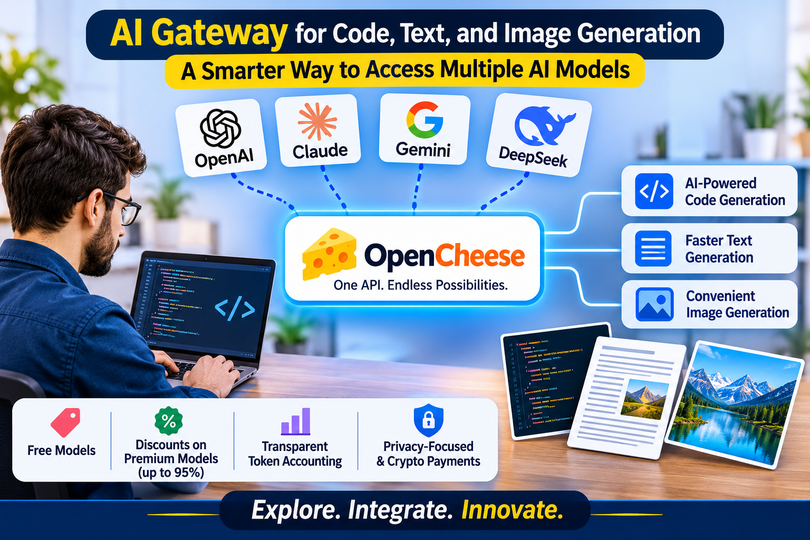
The platform connects users with models from providers such as OpenAI, Claude Opus, Gemini, and DeepSeek through a single API key. It also offers free model options and discounted access to selected premium services.
Here are some important features that make this approach useful.
1. Multiple AI Models Through One API Key
Managing separate API keys can become frustrating when an application depends on several AI providers.
OpenCheese simplifies this process by providing access to supported models through one API key. Developers can explore different AI technologies without repeatedly setting up individual provider integrations.
This centralized approach can make development workflows easier to organize and maintain.
2. AI-Powered Code Generation
Software development is one of the most popular applications of artificial intelligence. Coding models can help developers write functions, explain programming concepts, identify potential errors, and improve repetitive development tasks.
For startups and independent developers, these capabilities can save time during prototyping and application development.
A unified gateway makes it easier to explore different coding models and compare their responses. Developers can choose an appropriate model depending on programming complexity and project requirements.
However, AI-generated code should always be reviewed, tested, and checked for security issues before production use.
3. Faster and More Flexible Text Generation
Businesses and content creators regularly need written material for websites, marketing campaigns, product descriptions, emails, and customer communication.
AI language models can help produce initial drafts, summarize information, generate ideas, and organize written content.
Accessing multiple language models through one platform provides additional flexibility. Users can compare outputs, experiment with different writing approaches, and select models that suit their requirements.
This can be especially useful for marketing agencies, online businesses, and developers building content-generation applications.
4. Convenient Image Generation
Visual content has become essential for ecommerce stores, digital advertising, websites, and social media platforms.
AI image-generation models allow users to create visual concepts from written prompts. These tools can support product concepts, creative illustrations, marketing graphics, and other digital assets.
OpenCheese includes image-generation options alongside code and text capabilities, helping users explore different AI workflows through one centralized platform.
Available image features depend on the supported models and their individual capabilities.
5. Free Models and Discounted Premium Access
AI development costs can increase when applications generate large numbers of requests. Premium models may offer advanced capabilities, but they are not necessarily required for every task.
OpenCheese offers free AI models for code, text, and image generation. It also advertises discounts of up to 95% on selected premium models.
This combination allows developers to experiment with free options for suitable tasks while accessing more advanced models when necessary.
Actual pricing and savings depend on the selected model, usage, and applicable platform conditions.
6. Transparent Token Accounting
Understanding AI usage expenses is important for maintaining a predictable development budget.
Many providers use token-based pricing, meaning that charges depend on the amount of information processed and generated. Without clear tracking, developers may struggle to identify which requests are consuming the most resources.
OpenCheese provides transparent token accounting, helping users monitor their usage and understand API-related expenses.
This makes it easier to compare models and identify opportunities to reduce unnecessary consumption.
7. Privacy-Focused Features and Crypto Payments
Privacy is another important consideration when choosing an AI gateway. Developers may work with business documents, proprietary code, or other sensitive information.
OpenCheese promotes anonymous usage, zero training on user prompts, and cryptocurrency payment options. These features may appeal to users who prefer privacy-focused services and alternative payment methods.
However, developers should review current privacy terms and the data-handling policies of individual model providers before submitting confidential information.
Who Can Benefit from a Unified AI Gateway?
A centralized AI platform can support several professional groups.
Developers can integrate coding and language models into applications through a unified API.
Content creators can explore different models for writing, editing, and brainstorming.
Digital marketing agencies can use AI to support content production and creative campaigns.
Ecommerce businesses can experiment with product descriptions and AI-generated visual content.
Startups can test AI-powered features while managing development expenses more carefully.
The flexibility to access different models makes a unified gateway useful for projects of different sizes.
Final Thoughts
Artificial intelligence is creating new opportunities across software development, content production, and digital design. However, managing multiple AI providers independently can increase costs and complicate everyday workflows.
An AI gateway for code, text, and image generation provides a centralized alternative by connecting different AI models through one API.
OpenCheese combines access to multiple providers, free model options, discounted premium services, transparent token accounting, and privacy-focused features. For developers and businesses looking to explore different AI technologies, it offers an approach worth considering.
By choosing suitable models, monitoring usage, and taking advantage of available free options, users can build flexible AI-powered workflows while keeping unnecessary expenses under control.

